Showing posts with label Art. Show all posts

Saturday, August 14, 2010

Waltz with Bashir

At the time when I was about 15 years old in 1982 - 1983, I remember attending the daily ritual of watching the news with my parents and my brother and seeing these images from a war-stricken zone coming in. They were images of incredible destruction, of rubble and debris everywhere in the streets of what could hardly be called a city anymore and I remember asking myself: "But what is there that anyone would want to fight about ? Why on earth would one want to try and defend that pile of shelled walls and broken down buildings and why would another party want to capture them in the first place ?" I couldn't understand and I must confess that, at that age, I also didn't dive deeper in the origins of that conflict going on, but I do still remember the steady stream of images finding it's way onto our television screen almost like a daily diet.

The country was Lebanon and the city in rubble was Beirut. It was called "Operation Peace for Galilee". It is better known as the "Lebanon War". The increasing presence of Palestinians in Southern-Lebanon had raised the pressure on Israels borders and on the Lebanese Christians living in that area. So, in order to install a security zone of about forty kilometers wide from which the majority of enemy weapons couldn't hit Israeli territory anymore, Israel decided to invade Lebanon and clean it of the terrorists attacking them. Ariel Sharon, then defense minister, had a more elaborate plan in mind though: he wanted to push as far as the capital of Beirut and install a christian regime, friendly to Israel, headed by up-and-coming man Bashir Gemayel. Which is what happened, though Gemayel didn't enjoy his new function for very long: he was murdered, purportedly by a Syrian, Habib Shartouni, on September 14, less than a month after being in office.

Sixteen years after the facts, in which he took part himself as an Israeli soldier during the invasion, director Ari Folman confronted the world and himself again with this (another) dark page in the Middle-East history, releasing the cruelly beautiful animation movie "Waltz with Bashir" onto cinemascreens worldwide. He went on to be nominated for the Academy Award for "best foreign film" in 2008, which he lost, but grabbed the Golden Globe in the same category.

Watching the movie (unfortunately under mediocre conditions on the most ubiquitous screen of all, nowadays, i.e. YouTube) made me remember an article I had read one time in Newsweek and in which the author -I don't remember the name- pointed out the dangers of the big numbers with respect to "memory". For what difference does it make to an unknowing audience whether you say ten thousand or fifteen thousand people died in a war ? It's a difference of five thousand. So what ? People die every day, especially in wars. It becomes different when you say: Joe, Marc, Hendrik and Karl died in that war. And so did Karl's son, Jonathan, and his wife, Elena. And so on ... ten thousand names with ten thousand faces ... and then five thousand more names and faces ... father of ... wife of ... child of ... That's when the numbers stop being mere numbers and the memory has a chance to be carved in the soul, from where it can be erased  no more.

Such is the experience of watching "Waltz with Bashir", a movie about an individual going in search of his names, his faces and, literally, his memories. This movie is not just about "the" Lebanon War, which was just another war among an endless list of wars far too long for anyone to memorize: it's about the people that fought that war, that reported on that war, de- and reconstructing it from their own experience and perspectives and thus, layer after layer, revealing the essence of war, with the terrible culmination at the end. This movie is about creating a memory, such that no one will ever forget again. Therefore, the major part of what one easily could call a documentary, is made up of interviews by the director (Folman himself) with some of his brothers-in-arms at that time, which he goes to find as far as the Netherlands and in that way slowly piecing together his own role in the war.

Nothing in the movie is black and white, except for the video-board that served as basis for the stunning animation. Though the main accusation with respect to the massacres in Sabra and Shatilla committed by christian Phalangists and overseen by Israeli troops in vindication of the murder of Bashir Gemayel is shattering, the underlying tone is not.

We see people struggling with their ghosts, an outstanding example being the very opening scene where a pack of twenty-six bloodthirsty dogs runs along the streets, overhauling anyone and anything that stands in their way, to finally come to a halt under a window of an anonymous building from where a person watches them. It's the daily recurring nightmare of the soldier who, during the war, because anyone knew he wouldn't have been able to kill any human being, was ordered to shoot the dogs that started barking at the arrival of the Israeli troops as soon as they picked up an unknown scent, thus giving upfront warning to whichever enemy it was the soldiers were after.
We see people unexpectedly having to take over command and not knowing what to do. When one of Folman's interviewee's sees his commander being shot dead, he, as second in the line of command, has to take over. From the armored vehicle he is in, he orders his subordinates to shoot while they drive full speed through a field. They ask him what or who to shoot at. He answers "How the hell should I know ?" and when one of the soldiers asks: "Shouldn't we pray ?", the return is, "Ok, shoot and pray !"
We see soldiers being shot at by little boys with rocket-grenade launchers and returning fire full force in fear of their lives.
We see people sounding the alarm bell and being totally ignored.
But just as well, we see people, so many years after the facts, being totally at ease with the world and themselves, as if some things just never happened.

Folman makes one thing very, very clear: war is a strange, multi-headed monster. The strategy and the goal may be clear from the beginning, but underneath it's a shambles and that's what makes it so dangerous. There's no straight line towards that goal. Sabra and Shatilla, where approximately three-thousand people were slaughtered, was one of those detours in that war which maybe wasn't meant to be, but just had to happen because of the underlying chaos. The movie, far beyond the perimeter of this single war, forces anyone to face up to it's own responsibility when evil comes knocking at the door.

Supported by a great score, "Waltz with Bashir" has managed to translate the dreadful face of war in stunning animated scenes. The single most important flaw I find is exactly the choice to switch in the very last minute from animation to real footage exposing the cruelty of what happened in those Palestinian refugee camps in its' full bloody detail. In my opinion, there was no need for it. Without those images, the film would have been just as strong a statement. Oppositely, what we see are piles of bodies, of people with no names, with almost no faces. After telling about the mechanics of war, the atrocities, the hallucinations through the people who lived it and were there (the people being interviewed in the movie are real characters and all except two, also dubbed their own voices), this for me goes counter the rest of the movie. Yet let it not be me to condemn the choice of a director who, in this film, has given proof of an enormous integrity and therefore deserves our utmost respect.

Bashir may be dead, but this waltz is sure to linger in your mind for quite a while. As it should be ...

Sincerely Yours,

Tuesday, February 09, 2010

"Burn it Blue": some thoughts on Frida Kahlo

There's two movies I will always remember, both for the same reasons: the colors and the music.

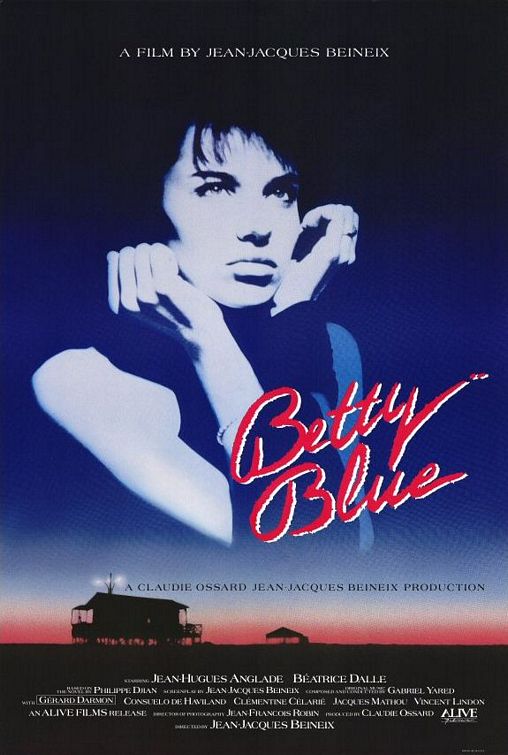
The first one is "37°2 Le Matin", also known as "Betty Blue", a movie by French director Jean-Jacques Beineix, about spare-time writer Zorg, who happens to meet Betty. The young lady is so enchanted by the scribblings from Zorg that her only concern  from then onwards is to get them published, leading to her insanity when that turns out to be more difficult than planned. The scenes where the couple meet and set out to start painting holiday bungalows on a beach, in pink and blue, are among the most amazing views I have ever come across in cinema. Those are scenes you don't forget, only by virtue of the colors and the rather fantastic minimalist score of Gabriel Yared.

The second one is "Frida", directed by Julie Taymor and starring Salma Hayek, about the life of Mexican artist Frida Kahlo. A significant part of her life she spent in the "Casa Azul", the house where she lived and which is a museum dedicated to the artist now. The vibrant blue, red and green colours of the house, like the colours of Kahlo's paintings, seem to splatter off the screen and watching it while listening to the grandiose wrinkled voice of Chavela Vargas in "La Llorona" or Caetano Veloso in "Burn it Blue" is another cinematic experience I'm not likely to forget anytime soon. And because of the movie, I got interested in this woman, who at times seemed to combine the superhuman with the everyday, down-to-earth normal human ...

So a couple of weeks ago I was happy to find, in a bookstore nearby, this little pocket book by French Nobel laureate Jean-Marie Gustave Le Clézio "Diego and Frida" ("Diego et Frida" (1993) published by Gallimard, "Folio", "Editions Flammarion", Paris), which details out the life and times of Frida Kahlo and focuses in particular on her stormy relationship with her just as notorious husband, Mexican revolutionary muralist Diego Rivera. It's near to impossible to not be touched by the story of Frida and Diego as it is laid out in the book, so I guess next I will be looking for the official biography of Frida Kahlo by Hayden Herrera (on which book the script of the movie was based), but while doing some further browsing on the web, I found this quote from Diego Rivera which struck me:

"Frida is the only example in the history of art of an artist who tore open her chest and heart to reveal the biological truth of her feelings. The only woman who has expressed in her work an art of the feelings, functions and creative power of woman".

When one isn't familiar with the sort of paintings Frida Kahlo produced, this may sound a bit over the top, but one look at some of her work reveals immediately what it is Diego was talking about when he referred to "the biological truth of her feelings".

Frida wasn't meant to live as long as she has, even be it only forty-eight years, but still she did. Diagnosed with polio at age six, which left her right leg thinner than the other, the major defining disaster of her life, however, was an accident she had when she was eighteen:

"On September 17, 1925, Kahlo was riding in a bus when the vehicle collided with a trolley car. She suffered serious injuries in the accident, including a broken spinal column, a broken collarbone, broken ribs, a broken pelvis, eleven fractures in her right leg, a crushed and dislocated right foot, and a dislocated shoulder. An iron handrail pierced her abdomen and her uterus, which seriously damaged her reproductive ability." (Wikipedia)

Incredible as it may seem, Frida recovered. She left the hospital just one month after she had been brought in, but for the rest of her life she would remain confined in the realm of sometimes excruciating pain as a consequence of her accident, pain which couldn't be resolved despite the thirty-five operations she had during her life. During her long revalidation at the house of her parents, where she was almost litterally harnassed to the bed, what started as a way to fight boredom and loneliness and waves of despair would ultimately become the instrument through which she faced the world and what brought her fame: painting. Her mother bought her a mirror which hung over her bed so Frida could see the subject she would keep reproducing on canvas during the rest of her life, which was herself. Yet, the acquaintance with Frida Kahlo's work is not an easy one, for her universe is not something a lot of people can relate to. It does make crystal clear though what her husband had in mind when he referred to the biological truth of her feelings and "The Broken Column" (La columna rota, 1944) is one of the best examples.

This portrait of a bare-breasted Frida, weeping, stuck with nails all over her body, harnessed with strips of cloth and chest torn apart to reveal that broken spine, represented as a column from a classic Greek temple, is the biggest endorsement of the truth of her husbands' words. For this self-portrait, she let go of her usual elaborate Tehuana costumes in which she normally dressed and let her hair hang down, as if to strip herself of any adornment and make-up and just to show her pure self and what it was she was hiding inside. But although everything in this painting shouts pain -even the landscape is torn up and shredded- yet the woman still  manages to appear beautiful and composed. The spine, or the "column", may be broken in pieces, but it is just as well intact and supporting Frida in holding her head up high. The whole drama and personality of this amazing woman is converging in this single image, the intensity of which, though in a totally different fashion, I could only compare to "The Scream" by Edvard Munch.

Through paintings like these, she made her entire life an exploration of the "self" and of that self's interaction with the outside world, especially with Diego, whom she called the "second disaster in her life", but with whom she choose as well to spend the better part of her life and on whom she feeded for her art, her communist activism and her personal feelings.

Her body eventually gave in, on July 13 1954, in the "Casa Azul" where she was born. As Le Clézio writes in his book, Diego never went back to Coyoacan after Frida's death. He  loathed the idea to have it become a museum, as he wanted it to be an open place, a sanctuary to the memory of his wife whom, notwithstanding everything that had happened between them (Diego may have been the only man ever to be diagnosed by his doctor to be "physically incapable of monogamy"), he had deeply admired and loved even more. Everything in the house, which did become a museum after all, is motionless, holding it's breath while awaiting the possible awakening of the niña.

Frida went, leaving behind on the last page of her diary the words "Espero alegre la salida - y espera nunca volver" (I hope my parting will be happy - and I hope to never return). With the legacy she left, she doesn't have to return: she is just here to stay.

Sincerely Yours.


Sitemeter